


Memories from Lawrence Central High School (LCHS)
A few memories from Jay's high school yearsSeptember 1959 - June 1962
| Welcome to LCHS
It is August or September of 1959, the first day of the fall semester for my sophomore high school year at Lawrence Central. My father was in the military, and my family had moved during the summer from his assignment in El Paso to his next assignment at the US Army Finance Center, so this was my first day at LCHS.
I had not been in the building before so I might have been a bit dazzled, So I stood up, worked my way out of the bleachers and exited towards the cafeteria. Obviously, this is something that is stuck in my memory, but the truth is nobody paid any attention to my relocation and I found the cafeteria and got the orientation for 10th, 11th and 12th graders.
The well-meaning teacher who met me at the entranceway, probably observed my small stature (I wrestled for LCHS as a junior in the 95 pound weight class) and just made a bad assumption. In my senior year I played on the newly-formed LCHS Tennis Team at perhaps 120 pounds.
Ms. Cuff was one of the more senior teachers at LCHS, both in tenure and also in age. She was also quite a lady in how she dressed, how she spoke, and how she interacted with people, especially her students. In recent years, the landscape of assigned literature for seniors in high school has undergone significant transformation, but more than 60 years ago the English curriculum was centered around classic works of literature that were deemed essential for cultural literacy and critical thinking. In that regard Ms Cuff had her students read and discuss some of the classics in American Literature: The Great Gatsby (F. Scott Fitzgerald), Of Mice and Men and The Grapes of Wrath (John Steinbeck), The Old Man and the Sea (Ernest Hemingway), The Scarlet Letter (Nathaniel Hawthorne), and To Kill a Mockingbird (Harper Lee) . . . to name a few. As I recall, it worked something like this: We had about 24 seniors in the class and she would break us into three groups of eight and assign each group a book to read and review and be prepared to comment on. And she would give each member the group a paperback loaner copy of the book to be reported on. On Book Report Day, the group would conduct a vigorous discussion from the pros and cons of the book as well as portions of the story that stood out. With Ms Cuff, beaming and delighting at our enthusiasm.
Of course, most students in the group did not read the complete book; they read the first chapter and the last chapter, and perhaps the equivalent of Cliff Notes . . . and proceeded to "fake it 'til we make it" on our reporting.
One day late in the school year, Mr. Smysor Bruce gave our geometry class a truly optional take home problem.
Well, I got the solution that night at home. The next day, before Geometry class, I passed Mr. Bruce in the hallway and said, "I got it!" He had no reaction; perhaps busy with other things or perhaps he did not expect any student to come up with the solution - but I did. |
 but a teacher caught my attention and directed me down the hall to the gymnasium, where I found a seat among many other students for what was probably a welcome and orientation. But to begin with, there was an announcement: "We are about to begin our program for freshman at Lawrence Central High School and if you are not a freshman, you need to be down the hall at the cafeteria."
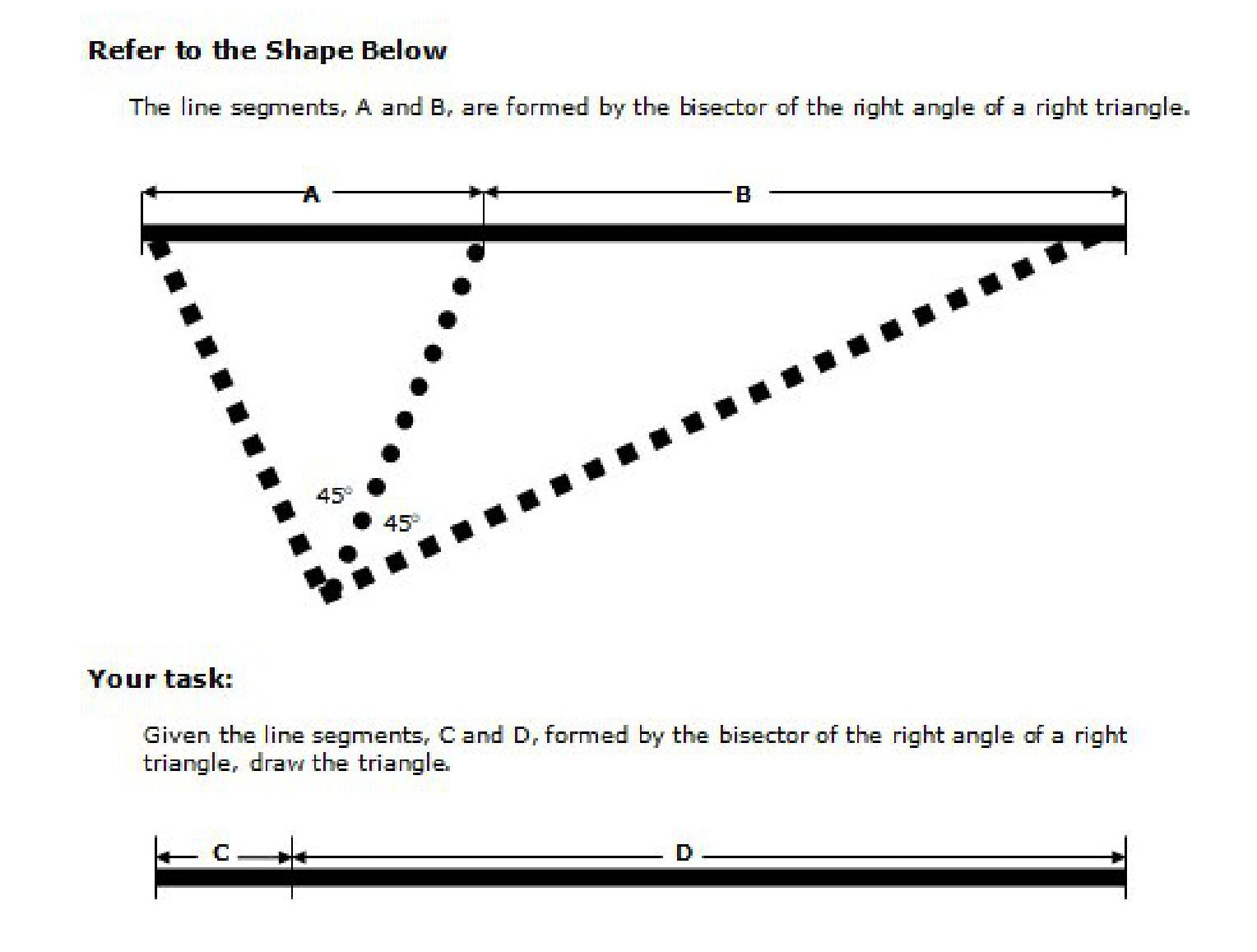 Everyone in class pretty much understood that this was a very difficult problem that we would not be able to solve.